Showing posts with label sub mercurcian. Show all posts

Wednesday, June 1, 2016

Student From University of British Columbia Discovers 4 Exoplanets From Kepler

A student at the University of British Columbia (UBC), Canada, has discovered four new exoplanets hidden in data from the Kepler spacecraft.

Michelle Kunimoto recently graduated from UBC with a Bachelor’s degree in physics and astronomy. As part of her coursework, she spent a few months looking closely at Kepler data, trying to find planets that others had overlooked.

In the end, she discovered four planets, (or planet candidates until they are independently confirmed.) The first planet is the size of Mercury, two are roughly Earth-sized, and one is slightly larger than Neptune. According to Kunimoto, the largest of the four, called KOI (Kepler Object of Interest) 408.05, is the most interesting. That one is 3,200 light years away from Earth and occupies the habitable zone of its star.

Sunday, March 29, 2015

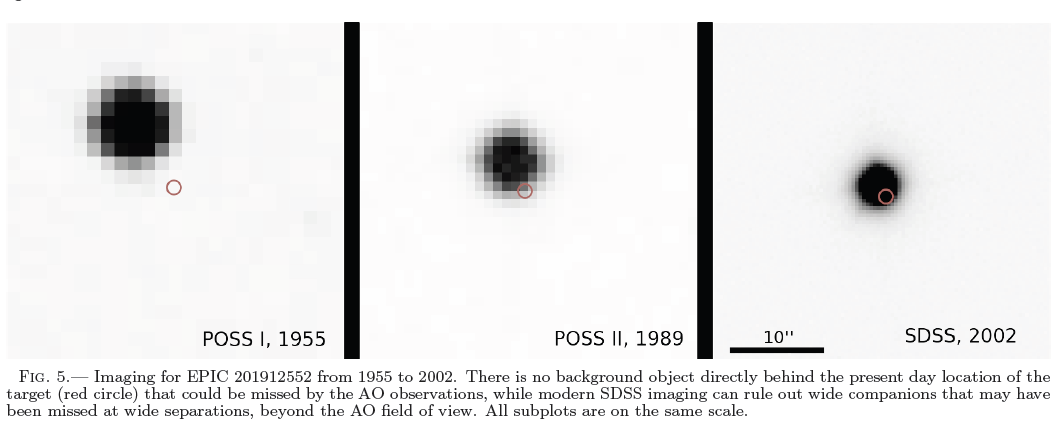
K2 Mission Gold: EPIC 201912552b, a Moon Sized Exoplanet With Earth's Insolation (and 17 other systems!)


Stellar and Planetary Properties of K2 Campaign 1 Candidates and Validation of 18 Systems, Including a Planet Receiving Earth-like Insolation

Authors:

Montet et al

Abstract:

The extended Kepler mission, K2, is now providing photometry of new fields every three months in a search for transiting planets. In a recent study, Foreman-Mackey and collaborators presented a list of 36 planet candidates orbiting 31 stars in K2 Campaign 1. In this contribution, we present stellar and planetary properties for all systems. We combine ground-based seeing-limited survey data and adaptive optics imaging with an automated transit analysis scheme to validate 18 candidates as planets and identify 6 candidates as likely false positives. Of particular interest is EPIC 201912552, a bright (K=8.9) M2 dwarf hosting a 2.24 \pm 0.25 Earth radius planet with an equilibrium temperature of 271 \pm 16 K and an orbital period of 33 days. We also present two new open-source software packages that enabled this analysis: isochrones, a flexible tool for fitting theoretical stellar models to observational data to determine stellar properties, and vespa, a new general-purpose procedure to calculate false positive probabilities and statistically validate transiting exoplanets.

It would not let me put all the exoplanet names in the labels, so I am putting them here:

EPIC 201208431b, EPIC 201338508b, EPIC 201338508c, EPIC 201367065b, EPIC 201367065c, EPIC 201505350b, EPIC 201505350c, EPIC 201577035b, EPIC 20163023b, EPIC 201629650b, EPIC 201702477b, EPIC 201736247b, EPIC 201754305b, EPIC 201754305c, EPIC 20185537b, EPIC 20192552b, EPIC 201912552b

Monday, March 17, 2014

KIC 12557548b: A Disintegrating sub-Mercury

Multiwavelength Observations of the Candidate Disintegrating sub-Mercury KIC 12557548b

Authors:

Croll et al

Abstract:

We present multiwavelength photometry, high angular resolution imaging, and radial velocities, of the unique and confounding disintegrating low-mass planet candidate KIC 12557548b. Our high angular resolution imaging, which includes spacebased HST/WFC3 observations in the optical, and groundbased Keck/NIRC2 observations in K'-band, allow us to rule-out background and foreground candidates at angular separations greater than 0.2 arcsec that are bright enough to be responsible for the transits we associate with KIC 12557548. Our radial velocity limit from Keck/HIRES allows us to rule-out bound, low-mass stellar companions to KIC 12557548 on orbits less than 10 years, as well as placing an upper-limit on the mass of the candidate planet of 1.2 Jupiter masses; therefore, the combination of our radial velocities, high angular-resolution imaging, and photometry are able to rule-out most false positive interpretations of the transits. Our precise multiwavelength photometry includes two simultaneous detections of the transit of KIC 12557548b using CFHT/WIRCam at 2.15 microns and the Kepler space telescope at 0.6 microns, as well as simultaneous null-detections of the transit by Kepler and HST/WFC3 at 1.4 microns. Our simultaneous HST/WFC3 and Kepler null-detections, provide no evidence for radically different transit depths at these wavelengths. Our simultaneous CFHT/WIRCam detections in the near-infrared and with Kepler in the optical reveal very similar transit depths (the average ratio of the transit depths at ~2.15 microns compared to ~0.6 microns is: 1.02 +/- 0.20). This suggests that if the transits we observe are due to scattering from single-size particles streaming from the planet in a comet-like tail, then the particles must be ~0.5 microns in radius or larger, which would favor that KIC 12557548b is a sub-Mercury, rather than super-Mercury, mass planet.