Atmospheric Circulation and Cloud Evolution on the Highly Eccentric Extrasolar Planet HD 80606b
Authors:
Lewis et al
Abstract:
Observations of the highly-eccentric (e~0.9) hot-Jupiter HD 80606b with Spitzer have provided some of best probes of the physics at work in exoplanet atmospheres. By observing HD 80606b during its periapse passage, atmospheric radiative, advective, and chemical timescales can be directly measured and used to constrain fundamental planetary properties such as rotation period, tidal dissipation rate, and atmospheric composition (including aerosols). Here we present three-dimensional general circulation models for HD 80606b that aim to further explore the atmospheric physics shaping HD 80606b's observed Spitzer phase curves. We find that our models that assume a planetary rotation period twice that of the pseudo-synchronous rotation period best reproduce the phase variations observed for HD~80606b near periapse passage with Spitzer. Additionally, we find that the rapid formation/dissipation and vertical transport of clouds in HD 80606b's atmosphere near periapse passage likely shapes its observed phase variations. We predict that observations near periapse passage at visible wavelengths could constrain the composition and formation/advection timescales of the dominant cloud species in HD 80606b's atmosphere. The time-variable forcing experienced by exoplanets on eccentric orbits provides a unique and important window on radiative, dynamical, and chemical processes in planetary atmospheres and an important link between exoplanet observations and theory.
Showing posts with label HD 80606b. Show all posts
Showing posts with label HD 80606b. Show all posts
Thursday, September 7, 2017
Atmospheric Circulation and Cloud Evolution on the Highly Eccentric Extrasolar Planet HD 80606b

Wednesday, October 26, 2016
Does Eccentric Jupiter HD 80606b Influence its Host Star's Activity?
Figuiera et alAbstract:Aims:Several studies suggest that the activity level of a planet-host star can be influenced by the presence of a close-by orbiting planet. Moreover, the interaction mechanisms that have been proposed, magnetic interaction and tidal interaction, exhibit a very different dependence on orbital separation between the star and the planet. A detection of activity enhancement and characterization of its dependence on planetary orbital distance can, in principle, allow us to characterize the physical mechanism behind the activity enhancement.Methods:We used the HARPS-N spectrograph to measure the stellar activity level of HD 80606 during the planetary periastron passage and compared the activity measured to that close to apastron. Being characterized by an eccentricity of 0.93 and an orbital period of 111 days, the system's extreme variation in orbital separation makes it a perfect target to test our hypothesis.Results:We find no evidence for a variation in the activity level of the star as a function of planetary orbital distance, as measured by all activity indicators employed log(R′HK), Hα, NaI, and HeI. None of the models employed, whether magnetic interaction or tidal interaction, provides a good description of the data.Conclusions:We find no evidence for star-planet interaction in HD\,80606 at the moment of the periastron passage of its very eccentric planet. The straightforward explanation for the non-detection is the absence of interaction as a result of a low magnetic field strength on either the planet or the star and of the low level of tidal interaction between the two. However, we cannot exclude two scenarios: i) the interaction can be instantaneous and of magnetic origin, being concentrated on the substellar point and its surrounding area, and ii) the interaction can lead to a delayed activity enhancement.
Thursday, September 8, 2016
Direct Measure of Radiative and Dynamical Properties of hot Jupiter Atmospheres
Authors:de Wit et alAbstract:Two decades after the discovery of 51 Peg b, the formation processes and atmospheres of short-period gas giants remain poorly understood. Observations of eccentric systems provide key insights on those topics as they can illuminate how a planet's atmosphere responds to changes in incident flux. We report here the analysis of multi-day multi-channel photometry of the eccentric (e~ 0.93) hot Jupiter HD 80606 b obtained with the Spitzer Space Telescope. The planet's extreme eccentricity combined with the long coverage and exquisite precision of new periastron-passage observations allow us to break the degeneracy between the radiative and dynamical timescales of HD 80606 b's atmosphere and constrain its global thermal response. Our analysis reveals that the atmospheric layers probed heat rapidly (~4 hr radiative timescale) from
Thursday, March 31, 2016
HD 80606b Gets Pop Sci Written up
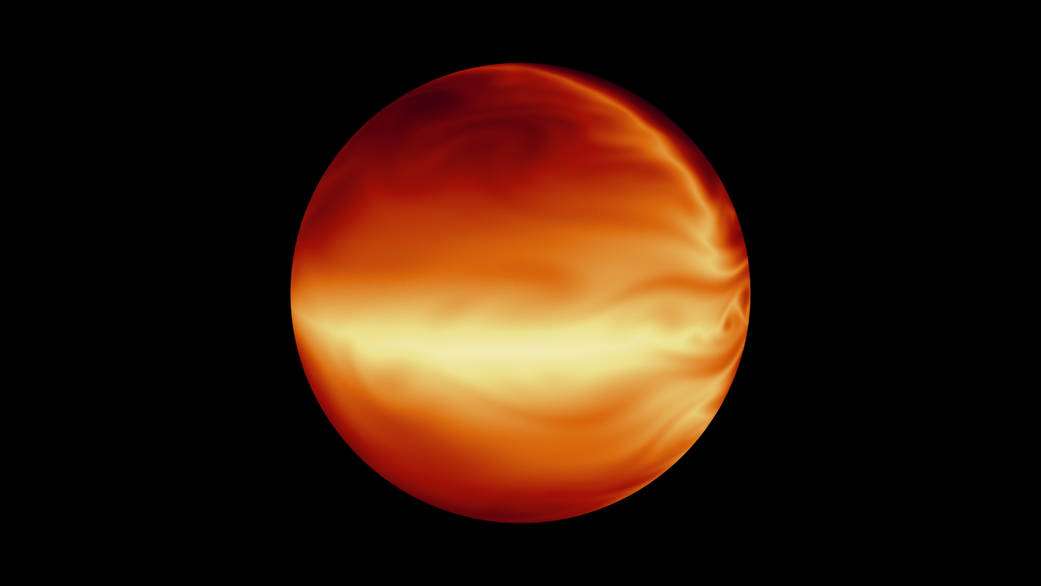
Since scientists started identifying lots of planets orbiting distant stars in the past decade, one of the weirder types is the surprisingly common "hot Jupiter" -- a gas giant like the ones we know that orbits very close to its star. Now NASA's Spitzer space telescope has spotted a particularly weird hot Jupiter that's more of a "very hot and cold Jupiter."
The planet, called HD 80606b, is about 190 light-years from Earth and has a highly eccentric orbit around its star that's more like that of a comet than the planets in our solar system. Every 111 days, the planet passes so close around its star that it almost touches it -- if it were able, it could probably reach out and high-five or fist-bump its sun. It then swings farther away from its star (a little less than the distance between our sun and Earth) before doing a U-turn at the other end of its elliptical orbit to repeat the cycle.
link.
Wednesday, March 9, 2016
Binary Stars HD80606 & HD80607 Have an Interesting History for the Gas Giant's Migration Causing no Rocky Exoplanets to Form
Detailed Abundances of Planet-Hosting Wide Binaries. II. HD80606 + HD80607
Authors:
Mack et al
Abstract:
We present a detailed chemical abundance analysis of 15 elements in the planet-hosting wide binary system HD80606 + HD80607 using Keck/HIRES spectra. As in our previous analysis of the planet-hosting wide binary HD20782 + HD20781, we presume that these two G5 dwarf stars formed together and therefore had identical primordial abundances. In this binary, HD80606 hosts an eccentric (e≈0.93) giant planet at ∼0.5 AU, but HD80607 has no detected planets. If close-in giant planets on eccentric orbits are efficient at scattering rocky planetary material into their host stars, then HD80606 should show evidence of having accreted rocky material while HD80607 should not. Here we show that the trends of abundance versus element condensation temperature for HD80606 and HD80607 are statistically indistinguishable, corroborating the recent result of Saffe et al. This could suggest that both stars accreted similar amounts of rocky material; indeed, our model for the chemical signature of rocky planet accretion indicates that HD80606 could have accreted up to 2.5~M⊕ of rocky material---about half that contained in the Solar System and primordial asteroid belt---relative to HD80607 and still be consistent with the data. Since HD80607 has no known giant planets that might have pushed rocky planet material via migration onto that star, we consider it more likely that HD80606/07 experienced essentially no rocky planet accretion. This in turn suggests that the migration history of the HD80606 giant planet must have been such that it ejected any close-in planetary material that might have otherwise been shepherded onto the star.
Wednesday, July 29, 2015
Close-in Giant Exoplanets Probably Preclude Terrestrial Exoplanet Formation
HD 80606: Searching the chemical signature of planet formation
Authors:
Saffe et al
Abstract:
Binary systems with similar components are ideal laboratories which allow several physical processes to be tested, such as the possible chemical pattern imprinted by the planet formation process. Aims. We explore the probable chemical signature of planet formation in the remarkable binary system HD 80606 - HD 80607. The star HD 80606 hosts a giant planet with 4 MJup detected by both transit and radial velocity techniques, being one of the most eccentric planets detected to date. We study condensation temperature Tc trends of volatile and refractory element abundances to determine whether there is a depletion of refractories that could be related to the terrestrial planet formation. Methods. We carried out a high-precision abundance determination in both components of the binary system, using a line-by-line strictly differential approach, using the Sun as a reference and then using HD 80606 as reference. We used an updated version of the program FUNDPAR, together with ATLAS9 model atmospheres and the MOOG code. Conclusions. From the study of Tc trends, we concluded that the stars HD 80606 and HD 80607 do not seem to be depleted in refractory elements, which is different for the case of the Sun. Then, the terrestrial planet formation would have been less efficient in the components of this binary system than in the Sun. The lack of a trend for refractory elements with Tc between both stars implies that the presence of a giant planet do not neccesarily imprint a chemical signature in their host stars, similar to the recent result of Liu et al. (2014). This is also in agreement with Melendez et al. (2009), who suggest that the presence of close-in giant planets might prevent the formation of terrestrial planets. Finally, we speculate about a possible planet around the star HD 80607.
Tuesday, December 16, 2014
Hot Jupiters in Open Clusters
Dynamical Interactions Make Hot Jupiters in Open Star Clusters
Authors:
Shara et al
Abstract:
Explaining the origin and evolution of exoplanetary "hot Jupiters" remains a significant challenge. One possible mechanism for their production is planet-planet interactions, which produces hot Jupiters from planets born far from their host stars but near their dynamical stability limits. In the much more likely case of planets born far from their dynamical stability limits, can hot Jupiters can be formed in star clusters? Our N-body simulations of planetary systems inside star clusters answer this question in the affirmative, and show that hot Jupiter formation is not a rare event. We detail three case studies of the dynamics-induced births of hot Jupiters on highly eccentric orbits that can only occur inside star clusters. The hot Jupiters' orbits bear remarkable similarities to those of some of the most extreme exoplanets known: HAT-P-32 b, HAT-P-2 b, HD 80606 b and GJ 876 d. If stellar perturbations formed these hot Jupiters then our simulations predict that these very hot, inner planets are sometimes accompanied by much more distant gas giants in highly eccentric orbits.
Subscribe to:
Posts (Atom)