Showing posts with label jwst. Show all posts

Monday, October 2, 2017

NASA's Next Space Telescope (JWST) is Delayed

NASA announced Sept. 28 that the launch of the James Webb Space Telescope mission, which had been planned for next fall, will now be delayed until the spring of 2019.

In a statement posted on the agency’s website, NASA said that an assessment of overall work needed to complete integration and testing of the $8 billion spacecraft led to the decision to postpone the launch by about half a year.

“The change in launch timing is not indicative of hardware or technical performance concerns,” Thomas Zurbuchen, NASA associate administrator for science, said in the statement. “Rather, the integration of the various spacecraft elements is taking longer than expected.”

The release noted that testing of the telescope and its instruments “continues to go well and on schedule” in a thermal vacuum chamber at the Johnson Space Center but that the spacecraft bus and sunshield, being assembled at a Northrop Grumman facility in California, were suffering delays.

Wednesday, August 23, 2017

On The Feasibility of Exomoon Detection Via Exoplanet Phase Curve Spectral Contrast

On The Feasibility of Exomoon Detection Via Exoplanet Phase Curve Spectral Contrast

Authors:


Forgan et al

Abstract:
An exoplanet-exomoon system presents a superposition of phase curves to observers - the dominant component varies according to the planetary period, and the lesser varies according to both the planetary and the lunar period. If the spectra of the two bodies differs significantly, then it is likely there are wavelength regimes where the contrast between the moon and planet is significantly larger. In principle, this effect could be used to isolate periodic oscillations in the combined phase curve. Being able to detect the exomoon component would allow a characterisation of the exomoon radius, and potentially some crude atmospheric data. We run a parameter survey of combined exoplanet-exomoon phase curves, which show that for most sets of planet-moon parameters, the lunar component of the phase curve is undetectable to current state-of-the-art transit observations. Even with future transit survey missions, measuring the exomoon signal will most likely require photometric precision of 10 parts per million or better. The only exception to this is if the moon is strongly tidally heated or in some way self-luminous. In this case, measurements of the phase curve at wavelengths greater than a few microns can be dominated by the lunar contribution. Instruments like the James Webb Space Telescope and its successors are needed to make this method feasible.

Friday, June 16, 2017

Trappist-1e Among Initial Observational Targets for the James Webb Space Telescope

Mission officials for NASA's James Webb Space Telescope announced some of the science targets the telescope will observe following its launch and commissioning. These specific observations are part of a program of Guaranteed Time Observations (GTO), which provides dedicated time to the scientists that helped design and build the telescope's four instruments.

"From the very first galaxies after the Big Bang, to searching for chemical fingerprints of life on Enceladus, Europa, and exoplanets like TRAPPIST-1e, Webb will be looking at some incredible things in our universe," said Eric Smith, James Webb Space Telescope Director at NASA Headquarters in Washington. "With over 2100 initial observations planned, there is no limit to what we might discover with this incredible telescope."

Thursday, January 12, 2017

Exploring Biases of Atmospheric Retrievals in Simulated JWST Transmission Spectra of Hot Jupiters


Authors:

Rocchetto et al

Abstract:

With a scheduled launch in October 2018, the James Webb Space Telescope (JWST) is expected to revolutionise the field of atmospheric characterization of exoplanets. The broad wavelength coverage and high sensitivity of its instruments will allow us to extract far more information from exoplanet spectra than what has been possible with current observations. In this paper, we investigate whether current retrieval methods will still be valid in the era of JWST, exploring common approximations used when retrieving transmission spectra of hot Jupiters. To assess biases, we use 1D photochemical models to simulate typical hot Jupiter cloud-free atmospheres and generate synthetic observations for a range of carbon-to-oxygen ratios. Then, we retrieve these spectra using TauREx, a Bayesian retrieval tool, using two methodologies: one assuming an isothermal atmosphere, and one assuming a parametrized temperature profile. Both methods assume constant-with-altitude abundances. We found that the isothermal approximation biases the retrieved parameters considerably, overestimating the abundances by about one order of magnitude. The retrieved abundances using the parametrized profile are usually within one sigma of the true state, and we found the retrieved uncertainties to be generally larger compared to the isothermal approximation. Interestingly, we found that using the parametrized temperature profile we could place tight constraints on the temperature structure. This opens the possibility to characterize the temperature profile of the terminator region of hot Jupiters. Lastly, we found that assuming a constant-with-altitude mixing ratio profile is a good approximation for most of the atmospheres under study.

Friday, December 23, 2016

Anomalies Detected in James Webb Telescope During Testing

Earlier this month, on Dec. 3, accelerometers at NASA’s Goddard Space Flight Center (GSFC) detected “anomalous readings” in a portion of the James Webb Space Telescope (JWST). These “readings” took place during vibration tests being conducted to simulate anticipated launch conditions.

Tuesday, November 15, 2016

James Webb Space Telescope Mirror Tested

Engineers and technicians working on the James Webb Space Telescope successfully completed the first important optical measurement of Webb's fully assembled primary mirror, called a Center of Curvature test.

Taking a "before" optical measurement of the telescope's deployed mirror is crucial before the telescope goes into several stages of rigorous mechanical testing. These tests will simulate the violent sound and vibration environments the telescope will experience inside its rocket on its way out into space. This environment is one of the most stressful structurally and could alter the shape and alignment of Webb's primary mirror, which could degrade or, in the worst case, ruin its performance.

Monday, June 13, 2016

Can the JWST Determine if the Trappist-1 System Exoplanets are Habitable?

Habitable worlds with JWST: transit spectroscopy of the TRAPPIST-1 system?

Authors:

Barstow et al

Abstract:

The recent discovery of three Earth-sized, potentially habitable planets around a nearby cool star, TRAPPIST-1, has provided three key targets for the upcoming James Webb Space Telescope (JWST). Depending on their atmospheric characteristics and precise orbit configurations, it is possible that any of the three planets may be in the liquid water habitable zone, meaning that they may be capable of supporting life. We find that present-day Earth levels of ozone, if present, would be detectable if JWST observes 60 transits for innermost planet 1b and 30 transits for 1c and 1d.

Wednesday, May 25, 2016

James Webb Space Telescope Instruments Installed


With surgical precision, two dozen engineers and technicians successfully installed the package of science instruments of the James Webb Space Telescope into the telescope structure. The package is the collection of cameras and spectrographs that will record the light collected by Webb's giant golden mirror.

Thursday, May 19, 2016

One Proposed Early Science Effort for JWST Will be Observing hot Jupiter WASP-62b's Atmosphere

Transiting Exoplanet Studies and Community Targets for JWST's Early Release Science Program

Authors:

Stevenson et al

Abstract:

The James Webb Space Telescope will revolutionize transiting exoplanet atmospheric science due to its capability for continuous, long-duration observations and its larger collecting area, spectral coverage, and spectral resolution compared to existing space-based facilities. However, it is unclear precisely how well JWST will perform and which of its myriad instruments and observing modes will be best suited for transiting exoplanet studies. In this article, we describe a prefatory JWST Early Release Science (ERS) program that focuses on testing specific observing modes to quickly give the community the data and experience it needs to plan more efficient and successful future transiting exoplanet characterization programs. We propose a multi-pronged approach wherein one aspect of the program focuses on observing transits of a single target with all of the recommended observing modes to identify and understand potential systematics, compare transmission spectra at overlapping and neighboring wavelength regions, confirm throughputs, and determine overall performances. In our search for transiting exoplanets that are well suited to achieving these goals, we identify 12 objects (dubbed "community targets") that meet our defined criteria. Currently, the most favorable target is WASP-62b because of its large predicted signal size, relatively bright host star, and location in JWST's continuous viewing zone. Since most of the community targets do not have well-characterized atmospheres, we recommend initiating preparatory observing programs to determine the presence of obscuring clouds/hazes within their atmospheres. Measurable spectroscopic features are needed to establish the optimal resolution and wavelength regions for exoplanet characterization. Other initiatives from our proposed ERS program include testing the instrument brightness limits and performing phase-curve observations.

Monday, May 9, 2016

Telling Apart ExoEarths and ExoVenuses With JWST

Telling twins apart: Exo-Earths and Venuses with transit spectroscopy

Authors:

Barstow et al

Abstract:

The planned launch of the James Webb Space Telescope in 2018 will herald a new era of exoplanet spectroscopy. JWST will be the first telescope sensitive enough to potentially characterize terrestrial planets from their transmission spectra. In this work, we explore the possibility that terrestrial planets with Venus-type and Earth-type atmospheres could be distinguished from each other using spectra obtained by JWST. If we find a terrestrial planet close to the liquid water habitable zone of an M5 star within a distance of 10 parsecs, it would be possible to detect atmospheric ozone if present in large enough quantities, which would enable an oxygen-rich atmosphere to be identified. However, the cloudiness of a Venus-type atmosphere would inhibit our ability to draw firm conclusions about the atmospheric composition, making any result ambiguous. Observing small, temperate planets with JWST requires significant investment of resources, with single targets requiring of order 100 transits to achieve sufficient signal to noise. The possibility of detecting a crucial feature such as the ozone signature would need to be carefully weighed against the likelihood of clouds obscuring gas absorption in the spectrum.

Monday, March 7, 2016

JWST Secondary Mirror Installed


The sole secondary mirror that will fly aboard NASA's James Webb Space Telescope was installed onto the telescope at NASA's Goddard Space Flight Center in Greenbelt, Maryland, on March 3, 2016.

The Webb telescope uses many mirrors to direct incoming light into the telescope's instruments. The secondary mirror is called the secondary mirror because it is the second surface the light from the cosmos hits on its route into the telescope.

Before its launch, engineers must build and test the telescope rigorously to ensure it survives its launch and its trip one million miles out into space. The James Webb Space Telescope is too large to fit into a rocket in its final shape so engineers have designed it to unfold like origami after its launch.

That unfolding, or deployment, includes the mirrors on the observatory, too.

The secondary mirror is supported by three struts that extend out from the large primary mirror. The struts are almost 25 feet long, yet are very strong and light-weight. They are hollow composite tubes, and the material is about 40-thousandths of an inch (about 1 millimeter) thick. They are built to withstand the temperature extremes of space.

Unlike the 18 primary segments that make up the biggest mirror on the Webb telescope, the secondary mirror is perfectly rounded. The mirror is also convex, so the reflective surface bulges toward a light source. It looks much like the curved mirrors on the walls near parking garage exits that let motorists see around corners. The quality of the secondary mirror surface is so good that the final surface at cold temperatures does not deviate from the design by more than a few millionths of a millimeter - or about one ten-thousandth the diameter of a human hair.

Tuesday, March 1, 2016

Quantifying and Predicting the Presence of Clouds in Exoplanet Atmospheres

Quantifying and Predicting the Presence of Clouds in Exoplanet Atmospheres

Authors:

Stevenson et al

Abstract:

One of the most outstanding issues in exoplanet characterization is understanding the prevalence of obscuring clouds and hazes in their atmospheres. The ability to predict the presence of clouds/hazes a priori is an important goal when faced with limited telescope resources and advancements in atmospheric characterization that rely on the detection of spectroscopic features. As a means to identify favorable targets for future studies with HST and JWST, we use published HST/WFC3 transmission spectra to determine the strength of each planet's water feature, as defined by the H2O - J index. By expressing this parameter in units of atmospheric scale height, we provide a means to efficiently compare the size of spectral features over a physically diverse sample of exoplanets. We find the H2O - J index to be strongly correlated with planet temperature when Teq less than 750+90−60 K and weakly correlated with surface gravity for planets with logg less than 3.2+0.3−0.2 dex. Otherwise, the median value of the H2O - J index is 1.8±0.3 H. Using these two physical parameters, we identify a division between "classes" of exoplanets, such that objects above Teq=700 K and logg=2.8 dex are more likely to have clearer atmospheres with stronger spectral features (H2O - J greater than 1) and those below at least one of these thresholds are increasingly likely to have predominantly cloudy atmospheres with muted spectral features (H2O - J less than 1). Additional high-precision measurements are needed to corroborate the reported trends.

Wednesday, February 10, 2016

Toward Direct Imaging of Low-Mass Gas-Giants with the James Webb Space Telescope

Toward Direct Imaging of Low-Mass Gas-Giants with the James Webb Space Telescope

Authors:

Schlieder et al

Abstract:

In preparation for observations with the James Webb Space Telescope (JWST), we have identified new members of the nearby, young M dwarf sample and compiled an up to date list of these stars. Here we summarize our efforts to identify young M dwarfs, describe the current sample, and detail its demographics in the context of direct planet imaging. We also describe our investigations of the unprecedented sensitivity of the JWST when imaging nearby, young M dwarfs. The JWST is the only near term facility capable of routinely pushing direct imaging capabilities around M dwarfs to sub-Jovian masses and will provide key insight into questions regarding low-mass gas-giant properties, frequency, formation, and architectures.

Wednesday, January 27, 2016

A Robot Installed the Mirrors for the James Webb Space Telescope


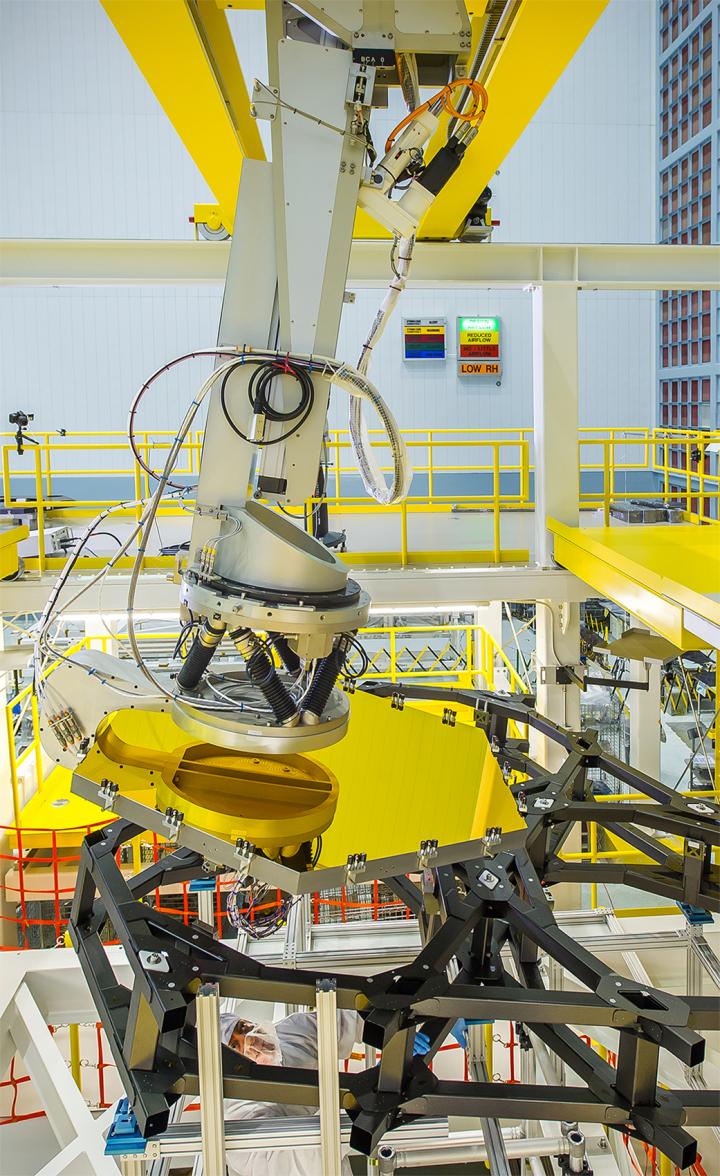
Inside a massive clean room at NASA's Goddard Space Flight Center in Greenbelt, Maryland the James Webb Space Telescope team is steadily installing the largest space telescope mirror ever. Unlike other space telescope mirrors, this one must be pieced together from segments using a high-precision robotic arm.

The team uses a robotic arm called the Primary Mirror Alignment and Integration Fixture to lift and lower each of Webb's 18 primary flight mirror segments to their locations on the telescope structure. Each of the mirrors is made with beryllium, chosen for its properties to withstand the super cold temperatures of space. Each segment also has a thin gold coating to reflect infrared light. These mirror segments will function as one when the telescope is in orbit.

"In order for the combination of mirror segments to function as a single mirror they must be placed within a few millimeters of one another, to fraction-of-a-millimeter accuracy. A human operator cannot place the mirrors that accurately, so we developed a robotic system to do the assembly," said NASA's James Webb Space Telescope Program Director Eric Smith, at Headquarters in Washington.

Sunday, January 10, 2016

How JWST Could be Used to Examine Transiting ExoPlanet Atmospheres

Characterizing transiting exoplanet atmospheres with JWST

Authors:

Greene et al

Abstract:

We explore how well James Webb Space Telescope (JWST) spectra will likely constrain bulk atmospheric properties of transiting exoplanets. We start by modeling the atmospheres of archetypal hot Jupiter, warm Neptune, warm sub-Neptune, and cool super-Earth planets with clear, cloudy, or high mean molecular weight atmospheres. Next we simulate the λ=1−11 μm transmission and emission spectra of these systems for several JWST instrument modes for single transit and eclipse events. We then perform retrievals to determine how well temperatures and molecular mixing ratios (CH4, CO, CO2, H2O, NH3) can be constrained. We find that λ=1−2.5 μm transmission spectra will often constrain the major molecular constituents of clear solar composition atmospheres well. Cloudy or high mean molecular weight atmospheres will often require full 1−11 μm spectra for good constraints, and emission data may be more useful in cases of sufficiently high Fp and high Fp/F∗. Strong temperature inversions in the solar composition hot Jupiter atmosphere should be detectable with 1−2.5+ μm emission spectra, and 1−5+ μm emission spectra will constrain the temperature-pressure profiles of warm planets. Transmission spectra over 1−5+ μm will constrain [Fe/H] values to better than 0.5 dex for the clear atmospheres of the hot and warm planets studied. Carbon-to-oxygen ratios can be constrained to better than a factor of 2 in some systems. We expect that these results will provide useful predictions of the scientific value of single event JWST spectra until its on-orbit performance is known.

Monday, December 28, 2015

James Webb Space Telescope's Mirror is Half Complete


Inside NASA's Goddard Space Flight Center's massive clean room in Greenbelt, Maryland, the ninth flight mirror was installed onto the telescope structure with a robotic arm. This marks the halfway completion point for the James Webb Space Telescope's segmented primary mirror.

The James Webb Space Telescope team has been working tirelessly to install all 18 of Webb's mirror segments onto the telescope structure.

"The years of planning and practicing is really paying dividends and the progress is really rewarding for everyone to see," said NASA's Optical Telescope Element Manager Lee Feinberg.

In these NASA images, the engineering team is seen using a robotic arm to lift and lower the hexagonal-shaped segment that measures just over 4.2 feet (1.3 meters) across and weighs approximately 88 pounds (40 kilograms). After being pieced together, the 18 primary mirror segments will work together as one large 21.3-foot (6.5-meter) mirror. The full installation is expected to be complete early in 2016.