Showing posts with label nasa. Show all posts

Sunday, November 26, 2017

Review Report on the WFIRST

An independent review board for NASA’s next flagship astronomy mission concluded in its final report that the project is “not executable” without additional funding or adjustments to the spacecraft.

NASA released the report, a 65-page document in the form of a PowerPoint presentation, Nov. 22, a month after the agency published its response calling for a reduction in the proposed cost of the Wide-Field Infrared Survey Telescope (WFIRST) and changes to its management.

The report, prepared by an outside committee established by NASA called the WFIRST Independent External Technical/Management/Cost Review (WIETR), found that various changes made to WFIRST since it was proposed as the top-ranking large, or flagship, mission in the 2010 astrophysics decadal survey created cost and technical difficulties.

“After multiple discussions that set the boundary conditions, NASA HQ made a series of decisions that set the stage for an approach and mission system concept that is more complex than probably anticipated from the point of view of scope, complexity, and the concomitant risks of implementation,” the report stated.

Monday, October 2, 2017

NASA's Next Space Telescope (JWST) is Delayed

NASA announced Sept. 28 that the launch of the James Webb Space Telescope mission, which had been planned for next fall, will now be delayed until the spring of 2019.

In a statement posted on the agency’s website, NASA said that an assessment of overall work needed to complete integration and testing of the $8 billion spacecraft led to the decision to postpone the launch by about half a year.

“The change in launch timing is not indicative of hardware or technical performance concerns,” Thomas Zurbuchen, NASA associate administrator for science, said in the statement. “Rather, the integration of the various spacecraft elements is taking longer than expected.”

The release noted that testing of the telescope and its instruments “continues to go well and on schedule” in a thermal vacuum chamber at the Johnson Space Center but that the spacecraft bus and sunshield, being assembled at a Northrop Grumman facility in California, were suffering delays.

Tuesday, June 27, 2017

Kepler Finds 219 New Exoplanets

This is the most comprehensive and detailed catalog release of candidate exoplanets, which are planets outside our solar system, from Kepler's first four years of data. It's also the final catalog from the spacecraft's view of the patch of sky in the Cygnus constellation.

NASA's Kepler space telescope team has released a mission catalog of planet candidates that introduces 219 new planet candidates, 10 of which are near-Earth size and orbiting in their star's habitable zone, which is the range of distance from a star where liquid water could pool on the surface of a rocky planet.

With the release of this catalog, derived from data publically available on the NASA Exoplanet Archive, there are now 4,034 planet candidates identified by Kepler. Of which, 2,335 have been verified as exoplanets. Of roughly 50 near-Earth size habitable zone candidates detected by Kepler, more than 30 have been verified.


Friday, December 23, 2016

Anomalies Detected in James Webb Telescope During Testing

Earlier this month, on Dec. 3, accelerometers at NASA’s Goddard Space Flight Center (GSFC) detected “anomalous readings” in a portion of the James Webb Space Telescope (JWST). These “readings” took place during vibration tests being conducted to simulate anticipated launch conditions.

Tuesday, November 15, 2016

James Webb Space Telescope Mirror Tested

Engineers and technicians working on the James Webb Space Telescope successfully completed the first important optical measurement of Webb's fully assembled primary mirror, called a Center of Curvature test.

Taking a "before" optical measurement of the telescope's deployed mirror is crucial before the telescope goes into several stages of rigorous mechanical testing. These tests will simulate the violent sound and vibration environments the telescope will experience inside its rocket on its way out into space. This environment is one of the most stressful structurally and could alter the shape and alignment of Webb's primary mirror, which could degrade or, in the worst case, ruin its performance.

Wednesday, August 10, 2016

WFIRST's Evolution

Many NASA missions and projects have become household names – Apollo, Hubble, and, more recently, Curiosity. These names are chosen with care, and the names themselves can change over the course of a project, from inception to completion. Tracking the changing names of a project can reveal the story of a mission's development. NASA’s next big “flagship” astronomy mission, following the ambitious James Webb Space Telescope due to be launched in 2018, is currently known as the Wide Field Infrared Survey Telescope (WFIRST). When NASA formally committed to flying WFIRST in February 2016, news stories stated that NASA had then "begun" work on WFIRST. This amused me because I, along with many of my colleagues, had already put hundreds of collective work-years into the development of WFIRST, under a slew of different names.

Sunday, April 24, 2016

Stellar Echo Imaging of Exoplanets: a NIAC award

Stellar Echo Imaging of Exoplanets

Chris Mann
Nanohmics, Inc.

All stars exhibit intensity fluctuations over several time scales, from nanoseconds to days; these intensity fluctuations echo off planetary bodies in the star system and provide an opportunity to detect and image exoplanets using modern computational imaging techniques. A mission utilizing distributed-aperture stellar echo detectors could provide continent-level imaging of exoplanets more readily than interferometric techniques, as high temporal resolution detection is less technically challenging and more cost effective than multi-kilometer-baseline fringe-tracking, particularly in a photon-starved regime. The concept is viable for detecting exoplanets at more diverse orbital inclinations than is possible with transit or radial velocity techniques.

Tuesday, March 1, 2016

The NASA K2 Mission Science Products and Their Performance Metrics

That's How We Roll: The NASA K2 Mission Science Products and Their Performance Metrics

Authors:

Van Cleve et al

Abstract:

NASA's exoplanet Discovery mission Kepler was reconstituted as the K2 mission a year after the failure of the 2nd of Kepler's 4 reaction wheels in May 2013. The new spacecraft pointing method now gives typical roll motion of 1.0 pixels peak-to-peak over 6 hours at the edges of the field, two orders of magnitude greater than for Kepler. Despite these roll errors, the flight system and its modified science data processing pipeline restores much of the photometric precision of the primary mission while viewing a wide variety of targets, thus turning adversity into diversity. We define metrics for data compression and pixel budget available in each campaign; the photometric noise on exoplanet transit and stellar activity time scales; residual correlations in corrected long cadence light curves; and the protection of test sinusoidal signals from overfitting in the systematic error removal process. We find that data compression and noise both increase linearly with radial distance from the center of the field of view, with the data compression proportional to star count as well. At the center, where roll motion is nearly negligible, the limiting 6 hour photometric precision for a quiet 12th magnitude star can be as low as 30 ppm, only 25% higher than that of Kepler. This noise performance is achieved without sacrificing signal fidelity; test sinusoids injected into the data are attenuated by less than 10% for signals with periods up 15 days. At time scales relevant to asteroseismology, light curves derived from K2 archive calibrated pixels have high-frequency noise amplitude within 40% of that achieved by Kepler. The improvements in K2 operations and science data analysis resulting from 1.5 yr of experience with this new mission concept, and quantified by the metrics in this paper, will support continuation of K2's already high level of scientific productivity in an extended K2 mission.

Wednesday, January 27, 2016

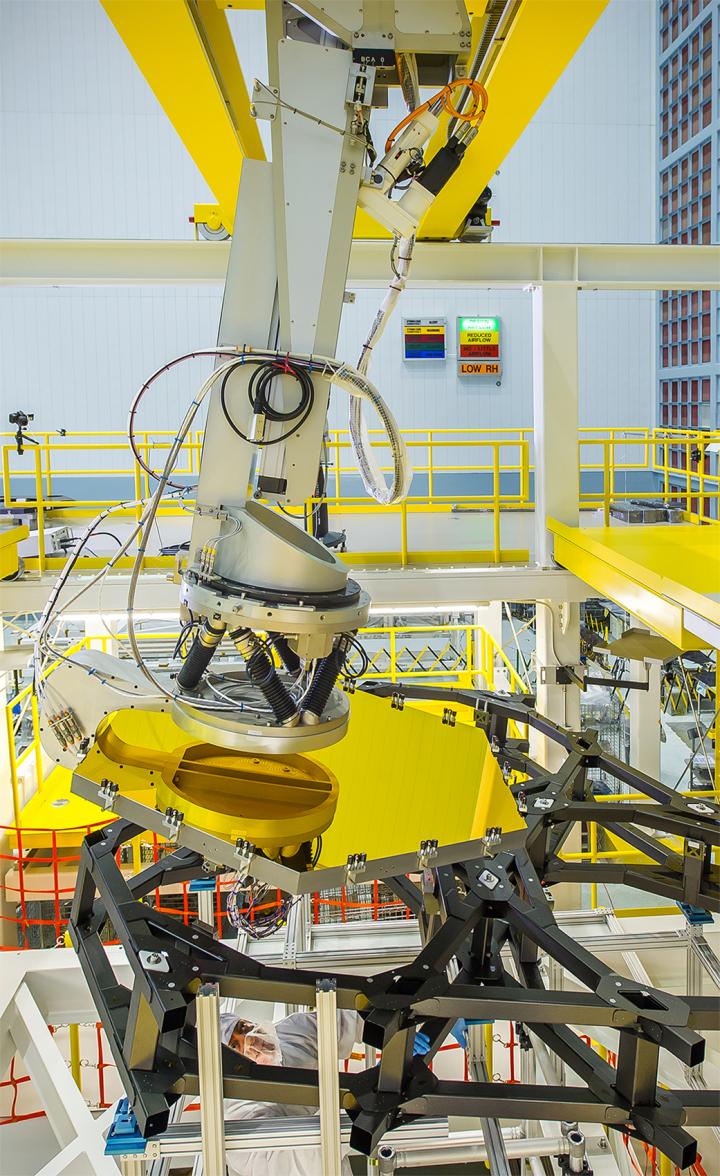
A Robot Installed the Mirrors for the James Webb Space Telescope


Inside a massive clean room at NASA's Goddard Space Flight Center in Greenbelt, Maryland the James Webb Space Telescope team is steadily installing the largest space telescope mirror ever. Unlike other space telescope mirrors, this one must be pieced together from segments using a high-precision robotic arm.

The team uses a robotic arm called the Primary Mirror Alignment and Integration Fixture to lift and lower each of Webb's 18 primary flight mirror segments to their locations on the telescope structure. Each of the mirrors is made with beryllium, chosen for its properties to withstand the super cold temperatures of space. Each segment also has a thin gold coating to reflect infrared light. These mirror segments will function as one when the telescope is in orbit.

"In order for the combination of mirror segments to function as a single mirror they must be placed within a few millimeters of one another, to fraction-of-a-millimeter accuracy. A human operator cannot place the mirrors that accurately, so we developed a robotic system to do the assembly," said NASA's James Webb Space Telescope Program Director Eric Smith, at Headquarters in Washington.

Monday, December 28, 2015

James Webb Space Telescope's Mirror is Half Complete


Inside NASA's Goddard Space Flight Center's massive clean room in Greenbelt, Maryland, the ninth flight mirror was installed onto the telescope structure with a robotic arm. This marks the halfway completion point for the James Webb Space Telescope's segmented primary mirror.

The James Webb Space Telescope team has been working tirelessly to install all 18 of Webb's mirror segments onto the telescope structure.

"The years of planning and practicing is really paying dividends and the progress is really rewarding for everyone to see," said NASA's Optical Telescope Element Manager Lee Feinberg.

In these NASA images, the engineering team is seen using a robotic arm to lift and lower the hexagonal-shaped segment that measures just over 4.2 feet (1.3 meters) across and weighs approximately 88 pounds (40 kilograms). After being pieced together, the 18 primary mirror segments will work together as one large 21.3-foot (6.5-meter) mirror. The full installation is expected to be complete early in 2016.

Friday, April 24, 2015

NASA's NExSS: The Nexus for Exoplanet System Science

NASA is bringing together experts spanning a variety of scientific fields for an unprecedented initiative dedicated to the search for life on planets outside our solar system.

The Nexus for Exoplanet System Science, or “NExSS”, hopes to better understand the various components of an exoplanet, as well as how the planet stars and neighbor planets interact to support life.

“This interdisciplinary endeavor connects top research teams and provides a synthesized approach in the search for planets with the greatest potential for signs of life,” says Jim Green, NASA’s Director of Planetary Science. “The hunt for exoplanets is not only a priority for astronomers, it’s of keen interest to planetary and climate scientists as well.”

The study of exoplanets – planets around other stars – is a relatively new field. The discovery of the first exoplanet around a star like our sun was made in 1995. Since the launch of NASA’s Kepler space telescope six years ago, more than 1,000 exoplanets have been found, with thousands of additional candidates waiting to be confirmed. Scientists are developing ways to confirm the habitability of these worlds and search for biosignatures, or signs of life.

The key to this effort is understanding how biology interacts with the atmosphere, geology, oceans, and interior of a planet, and how these interactions are affected by the host star. This “system science” approach will help scientists better understand how to look for life on exoplanets.

Thursday, April 23, 2015

NASA Goddard Adapting Climate Model for Exoplanet Simulations

The hunt for life beyond the Solar System is gaining new partners: NASA climatologists. After more than 30 years of studying Earth, a team at the NASA Goddard Institute for Space Studies (GISS) in New York will adapt its global climate model to simulate conditions on potentially habitable exoplanets. The effort is part of a broader push to identify Earth-like worlds that NASA will launch on 20 April at a meeting in Washington DC.

Already, the agency’s space-based Kepler telescope has pinpointed more than 1,000 alien planets by observing the brief interruption of starlight that signals a planet passing in front of its parent star. At least five of these planets are similar in size to Earth and located in the ‘habitable zone’, where liquid water could persist. The next step would be to detect light passing through exoplanet atmospheres, which could hold clues to conditions on these distant worlds.

Sunday, March 29, 2015

The Future of Radial Velocity Detection in Exoplanetary Science

Radial Velocity Prospects Current and Future: A White Paper Report prepared by the Study Analysis Group 8 for the Exoplanet Program Analysis Group (ExoPAG)

Authors:

Plavchan et al

Abstract:

The Study Analysis Group 8 of the NASA Exoplanet Analysis Group was convened to assess the current capabilities and the future potential of the precise radial velocity (PRV) method to advance the NASA goal to "search for planetary bodies and Earth-like planets in orbit around other stars.: (U.S. National Space Policy, June 28, 2010). PRVs complement other exoplanet detection methods, for example offering a direct path to obtaining the bulk density and thus the structure and composition of transiting exoplanets. Our analysis builds upon previous community input, including the ExoPlanet Community Report chapter on radial velocities in 2008, the 2010 Decadal Survey of Astronomy, the Penn State Precise Radial Velocities Workshop response to the Decadal Survey in 2010, and the NSF Portfolio Review in 2012. The radial-velocity detection of exoplanets is strongly endorsed by both the Astro 2010 Decadal Survey "New Worlds, New Horizons" and the NSF Portfolio Review, and the community has recommended robust investment in PRVs. The demands on telescope time for the above mission support, especially for systems of small planets, will exceed the number of nights available using instruments now in operation by a factor of at least several for TESS alone. Pushing down towards true Earth twins will require more photons (i.e. larger telescopes), more stable spectrographs than are currently available, better calibration, and better correction for stellar jitter. We outline four hypothetical situations for PRV work necessary to meet NASA mission exoplanet science objectives.

Monday, February 9, 2015

Hunt for Exomoons with Kepler Project Using NASA Pleiades Supercomputer


A team of 21st-century explorers working for the Hunt for Exomoons with Kepler (HEK) project, based at Harvard University, are searching for exomoons using data from NASA’s Kepler mission and the Pleiades supercomputer at the NASA Advanced Supercomputing (NAS) facility at NASA’s Ames Research Center.

The discovery of exomoons—moons situated beyond our own solar system—would add to the growing list of celestial objects detected by the Kepler telescope that could potentially harbor life in some form.

In the quest to find the first exomoon, HEK astronomers led by David Kipping at the Harvard-Smithsonian Center for Astrophysics have devised a unique, systematic computational approach that requires 5.2 million processor hours on Pleiades. Using their in-house LUNA light curve modeling algorithm and a massively parallel sampling algorithm called MultiNest, the project team simulates billions of possible star-planet-moon configurations and compares the results to the actual Kepler data to look for a good match. So far, the team has surveyed 56 of about 400 identified Kepler planet candidates that could have a detectable exomoon.


Monday, January 19, 2015

Future NASA/NSF Exoplanet Hunting Missions


The last several years have made it clear we are living in a golden era of extrasolar planet studies. Less than 20 years ago, astronomers discovered the first planets orbiting Sun-like stars. Now, the number of exoplanets is in the thousands, including a growing number of “Earth-like” planets, a designation based on some combination of the planets’ mass, radius, and orbit around their stars. Just this past Friday, for example, astronomers reported detecting three planets between 1.5 and 2.4 times the radius of the Earth orbiting a single star, one of which lies in the star’s habitable zone, where liquid water could exist on its surface.

We don’t know, however, if these or other Earth-like planets are really like the Earth in the characteristics that really count: whether they have atmospheres like the Earth, oceans of liquid water like the Earth, and life like the Earth. Those determinations are largely beyond the capabilities of ground- and space-based observatories in operation today. A new generation—arguably, generations—of instruments and telescopes will be needed to determine just how Earth-like these Earth-like worlds really are. And the ability to develop those instruments will depend, at least in part, on the ability of exoplanet scientists to come into agreement on what’s needed to enable that next round of discoveries.